
By: Wyatt Verlen (currently fending off djinn in the sands of the levant)
The birth of Islam was in many ways proto-bourgeois. The prophet of Islam, Mohammad, went to war with the feudal structures of Arabia, struck down their idols and the class of people who were the caretakers and priests of said idols, established a uniform code of laws, a universalist and exportable religious system, and a welfare system. The result was immeasurable prosperity for the time, a favorable environment for trade (it helps to trade if you know exactly what the rules are when dragging goods across the Levant), and a sophisticated (again, for the time) educational system. While Christianity also disrupted and revolted against the strictures of Roman society, namely the status of slaves, it became itself part of a feudal system, with the clerisy forming a distinct caste, all while the Islamic world proposed for the first time in history a religion that could be practiced by the individual, wherever the individual stood.
This did not go unnoticed by bourgeois thought. I can find favorable, if exotic-ized, assessments of Islam in Montesqueiu, Rousseau, Goethe, George Washington, among others. Jefferson owned a Quran, and unlike his copy of the New Testament, did not seem to bother re-writing it. Nietzsche seemed to praise Islam as “nearer to our tastes” as humans, than the anti-human religious system of Christianity, which dragged us into centuries of belief in original sin, priests, and so on. They appreciated Islam for its enlightening and simple monotheism, its belief in the inherent goodness of humanity (called fitra), love of learning (both of philosophy as well as of sciences), and its positive attitudes towards pleasure (unlike christianity’s firmly negative view of it).
None of this is meant to invoke an overly rosy position towards Islam, where there are problems. Islam also maintained slavery (albeit with a much more emancipatory and meritocratic attitude towards slaves), did not liberate women (although again we find that Islam vastly improved the lot of women from their place in pre-islamic civilization), and was eventually calcified into a system of clerical rule, estates, and so on (but again, when assessing the Islamic “Gunpowder empires” we find that each one had a more meritocratic system than the systems of Christian Europe, as well as things such as religious liberty unheard of elsewhere).
This brings us to the latest war-Trump’s all out assault on Iran. Whether or not America ends the Iranian regime is something that remains to be seen when the fog of war ends (it is not even, at this moment, entirely clear if regime change is the goal, or more limited ends would constitute a “victory”). I do not wish to get into the Islamic revolution, or do the ritual condemnation of it demanded in America (it has been said, and done, before). Needless to say, it did not establish socialism, and if anything, rejected the more emancipatory currents at the time.
But it represents another problem: The end of spiritual Islam as a political force. Like all religions, Islam has both an exoteric dimension, and an esoteric dimension. The early islamic world recognized, and nurtured the education of those interested in the esoteric dimension, which can be recognized for its genuine religiosity, integration of neo-platonism, and spirituality. Sometime in the 19th century, this was rejected in much of the Sunni muslim world, in favor of literalist interpretations of the religion that had very little to add as far as a spiritual dimension for individuals to develop themselves and add to their life.
The Shia world, however, was bound up in it, and could not simply abandon it, as it was a core aspect of Twelver Shia belief. This is not a theology lesson, but an interesting note to make when discussing Iran. Thus Iran, which is a Shia state, became the last outpost for those looking to study traditional Islamic “sciences” of spirituality.
What happened in the Sunni world? Those same literalist interpretations became a force either for reaction (as we saw with ISIS, Al-Queda, and so on), or something far stranger (which we will get to in one moment). The reactionary force of that literalism declined after the defeat of ISIS-Daesh in Syria and Iraq, which to use modern parlance, took the meme too far for comfort from most of the Islamic world (including the very same countries that preach said form of Islam). Meanwhile, the gulf states liberalized, each becoming more like generic commercial states, with oil, than they had been in the past (Dubai, more remarkably, became a sort of libertine playground of the ultra-wealthy, with the death penalty, not unlike Singapore, but that is a different story).
The Islam that is literalist did not entirely go away, however. Salafi preachers still dominate the gulf states in ways that the west cannot fully understand. But in the past 20 years those same preachers morphed into something closer to Joel Osteen’s prosperity and self-help gospel than the behead-philipino guestworkers-for-sorcery preachers they had been before. Just to name names (I am a petty bitch like that), some stand to mind if you keep a watchful eye over the Islamic world, and popular preachers like “Mufti Menk” and “Faris Al-Hammadi” basically preach self-help, prosperity, and so on, with a Quran in hand, all while demanding quietism for believing Muslims, respect for the state, and even rapprochement with Israel, long a taboo in the Muslim world. And these guys have lots, and lots, of muslims around the world watching them, despite the fact they are intellectual mediocrities and not particularly interesting.
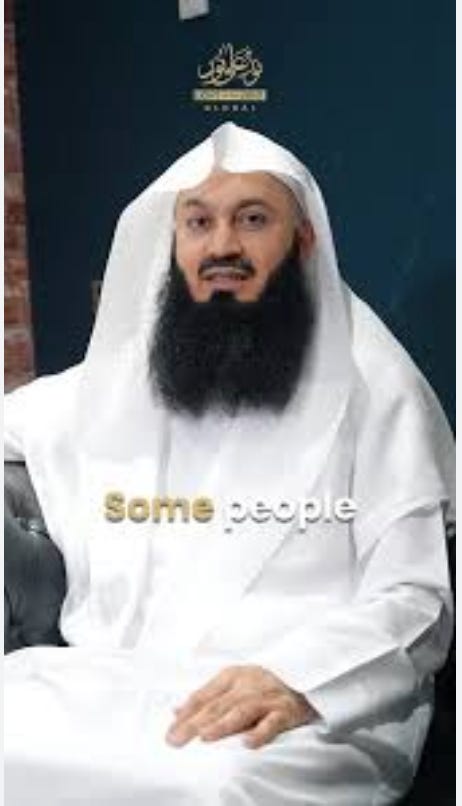
The Iranian state tried to hold on to something deeper, stretching back over a milennium, in the islamic world. It continued to empower marja and statesmen who had studied the esoteric sciences of Islam fused with the best of western philosophy (the current secretary of national security in Iran, Ali Larijani, has a PhD in Kantian philosophy and mathematics). Unlike the gulf-states, it encouraged women to take up education, not as a matter of feminism, but because it subscribed to the old Muslim world’s belief that education is a higher good.
Again, unlike more “tankie” and “anti-imperialist” leftists, I won’t describe the Islamic Republic using terms like “good”, anymore than I will use the paradigms of anti-fascist leftists and refer to it as “bad”. The world is more complicated than both of these epithets, and it really isn’t the point I am trying to make.
The point I am trying to make is that the middle east, and the Islamic world more broadly, has decided that it is better to make money than to develop ones intellect. It has decided to fully shed off its more authentic intellectual past for a less intellectually and spiritually rigorous view of its faith. Iran, under these conditions, perhaps belongs to the past, and for this reason history has caught up with it.
If the Iranian regime falls, so too will Islam, as any sort of coherent spirituality, also fall, and it will be replaced with something else entirely. Politically, the counterweight to lunatic sunni fringe groups like ISIS will also fall, so maybe they will have more free reign in the region as well, but that too is another discussion for another day.
Was there another way? Ali Shariati proposed that the emancipatory currents in Shiism (namely, the anti-tyrannical history of Shia Imams standing up to tyrants being an inspiration to the religious masses to establish socialism) could be harnessed. The Iranian government sort of half-integrated this proposal, which led them to have militia units called things like “Organization for Mobilization of the Oppressed” and so on, and a nationalized oil industry. Shariati’s Islam could outpace history because it proposed Islam was a historical force that would eventually lead towards utopia. But it never got fully there, and secularization happened in front of the TV screen and internet cafe slowly but surely.
Is there a lesson in this? Perhaps it is that the past cannot survive the future.
And the future is very much being told how to make money, and little else, if the current world holds the way it is.
Well, you ain't lying